|
Model |
Description |
Price |
Photo |
| TWM-48001 |
US armored infantry two figure set 1/48 scale resin kit,
sculpted by Manel Arin.
Brief history: This resin figure set is a pair of United States
Armored Infantry, typical of the European and Mediterranean Theatres of
Operations (Tunisia, Sicily, Italy, D-Day, Normandy Campaign, France
1944), both dressed in Winter Combat Jackets, HBT Trousers and M1938
Leggings. The web equipment is limited to the M1936 pistol belt, the
M1911A1 pistol in a M1916 leather holster, and a M1 Carbine. Although not
designed specifically for winter campaigns, these figures are easily
adaptable for use in cold weather scenes thanks to their poses, uniforms,
and associated gear. |
$19.99 
|


|
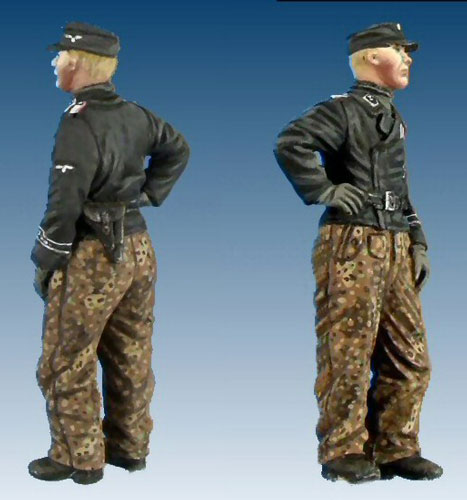
| TWM-48002 |
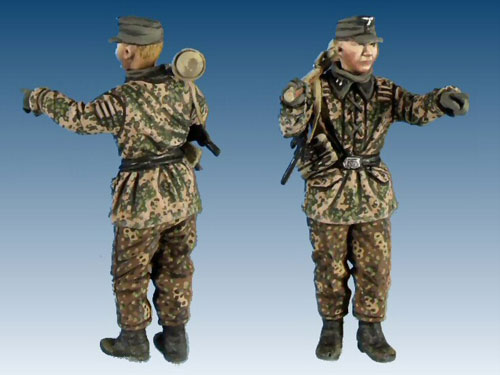
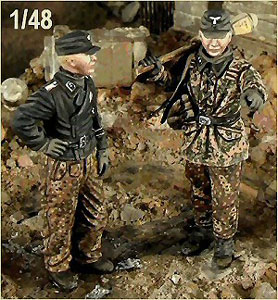
Waffen SS, Ardennes, 1944 two figure set 1/48 scale resin
kit, sculpted by Manel Arin.
Brief history: Based upon the well-known artwork of Ron Volstad,
this resin figure set depicts two members of the Kampfgruppe Peiper in the
Belgian town of Stoumont in December 1944. The panzer crewman wears the
standard SS pattern black Panzerjacke, black Einheitsmütze, and Dot
pattern camouflaged drill trousers for Armored Personnel. The
panzergrenadier wears the M1942, type 2 Smock printed in Oak Leaf
"A" summer side, M-44 Dot pattern camouflaged trousers, and
M1943 Einheitsfeldmütze field cap; armed with an MP40, a single set of
canvas pouches, and a Panzerfaust. It is possible, however, to paint
trousers and smock in other camo patterns, or even in single field grey
color for the trousers. |
$19.99 
|

|
| TWM-48003 |
Soviet summer scouts two figure set 1/48 scale resin kit,
sculpted by Manel Arin.
Brief history: This first set of "Razvedchik" includes 2 Red
Army scouts dressed in the two-piece garment with an "amoeba"
camouflage pattern dating from 1937-38, worn over the standard 1943 field
uniform and pilotka field cap. Armed with the German MP40 (captured from
the enemy) and the PPS-43 sub-machine guns, the rest of the equipment is
minimal: binoculars (also often captured from the German opponents), ammo
pouches, a Tokarev pistol in its holster, and a map case. The
"amoeba" pattern camouflaged coverall was a loose fitting cotton
garment, very baggy, with a large hood, intended to be worn by special
forces, notably scouts, snipers, engineer scouts and mountain troops. It
was produced in several shades of black or dark brown printed in large
rounded splotches over a green or khaki background. |
$19.99 
|


|
| TWM-48004 |
Winter German infantry two figure set 1/48 scale resin kit,
sculpted by Manel Arin.
Brief history: Perfectly adapted to the frozen conditions of the often
harsh sub-zero combat situations of the Eastern Front, these two German
soldiers wear the standard padded, reversible, camouflage, winter suit
with reversible mittens produced from 1942 onwards in many varieties of
camouflage patterns and designs. The rest of the infantry equipment
includes leather-reinforced felt winter boots, M1935 helmet, MP40 SMG with
ammo pouches, two stick grenades tucked into the belt, gash mask and
canteen. The hooded German soldier has a Walther P38 in a soft-shell
holster and a 84/98 bayonet. Both are equipped with short 10x50
binoculars. The reversible winter suit was designed to be loose fitting to
allow the Landser´s equipment to be worn under the jacket, protecting
ammunition and canteens from the extreme cold. The reversible winter suit
provided room for additional underclothing and allowed freedom of
movement. |
$19.99 
|


|
| TWM-48005 |
Desert Rats two figure set 1/48 scale resin kit, sculpted by
Manel Arin.
Brief history: Typical of the North African Theatre of Operations and
the fighting against the Desert Fox´s DAK in Libya and Egypt, this pair
of soldiers represent the early Western Desert Force and late Eighth Army
in summer. The Australian soldier wears a "Digger" hat, tropical
shirt, 1941 pattern khaki drill shorts, hosetops, puttees, 1937 Pattern
web equipment, haversack, respirator on the left hip alongside the Nº 1 (SMLE)
bayonet scabbard, standard .303in SMLE Nº 1 Mk III rifle, and heavy
entrenching tool. His British companion, who easily can be used as an
infantryman, artilleryman or as you need for your scenes and dioramas,
also wears tropical shirt and khaki drill shorts, hosetops and web ankles;
the helmet is the standard MK II steel helmet model. The heads are also
interchangeable to allow for flexibility of use in different settings. |
$19.99 
|


|
| TWM-48006 |
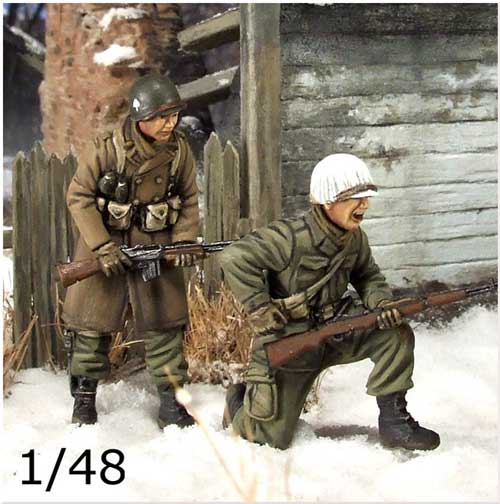
US Airborne Ardennes Set 1 two figure set 1/48 scale resin
kit, sculpted by Manel Arin.
Brief history: Bastogne´s defense by the 101 AIRBORNE and some other
units against the German Fifth Panzer Army in the last 2 weeks of 1944
became a symbol for the US Army in the ETO. The battledress of the airborne
troops in that winter battle differed little from other GIs, but there were
some evident distinctive features such as the extra cargo pockets added on
the M43 trousers or the M3 fighting knife strapped on the lower leg. The
M1942 wool overcoat remained the standard cold weather garment until the
war´s end, but due to the lack of winter supplies many soldiers fought
without that item. Winter rubber overshoes, scarves and gloves were also
worn, although not widely issued. The web-gear of these paratroopers on
combat patrol duties in the outskirts of Bastogne is very simple: the
Browning Automatic Rifle with ammo pouches belt and suspenders, and the M1
Garand with pistol belt and cloth bandoleers. The helmets are supposed to be
the M1C airborne model, covered sometimes with white bed-sheets as
improvised winter camouflage cover. |
$19.99 
|
 |
| TWM-48007 |
USMC Pacific Set 1 two figure set 1/48 scale resin kit,
sculpted by Manel Arin.
Brief history: This pair of “devil dogs” are typical of the Pacific
campaigns from Tarawa onwards. The green two-piece utility suit (also called
“dungaree”), made of hardwearing cotton herringbone twill (HBT), was first
issued on November 1941, and consisted of a shirt with 3 flapless patch
pockets and trousers with front and hip pockets. The Marines also adopted
their own two-piece camouflage utility uniform in 1943, provided in two
spotted, color combinations (called “frog” pattern”), greenish and brownish
for reversible garments, and widely issued by the time of the Tarawa and
Bougainville operations. Both Marines are armed with the M1 Garand, M1
helmets with camouflage cover, Army pattern canteens, K-BAR knife, jungle
first aid kits in M1942 pouch, cartridges belt for M1 ammo and pistol belt
with Colt M1911A1 pistol holster. |
$19.99 
|
 |
| TWM-48008 |
Winter Soviet Infantry with mine dog two figure set (plus
dog) 1/48 scale resin kit, sculpted by Manel Arin.
Brief history: The experience in Finland led to the development of new
winter gear, and the winter fighting of 1941-1942 forced the adoption of
some of these garments. These soviet soldiers are warmly dressed in the
shuba sheepskin coats, shapka-ushanka cap and M1940 steel helmet. One of
them is armed with a PPSh-41 submachine gun, while the other has a Tokarev
pistol in his holster fitted in the belt. Hungry dogs trained to crawl under
tanks to get their food were fitted with special harness containing 10-12
Kgs of high explosive, and a trigger pin connected to a detonator. This
soviet attempt to develop a “guided” anti-tank mine was used at least until
the Kursk battle, but German sources speak about the poor effectiveness of
this “weapon”. The sad fate of the dogs was to die under the tank, to be
shot by the Germans to prevent tank damage, or by the soviets if the dog
returned to the soviet lines lost and with the device intact.
Temporarily out of stock |
$19.99 
|
 |
| |
|
|
|